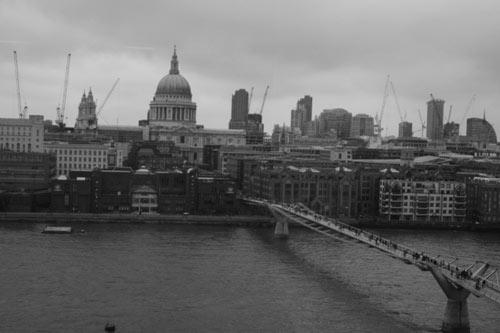
London's waiting Sisterly!
Photo: Parham Shahrjerdi
The poem opens on the site of a massacre, a beheading, a blood letting which happens in writing, to the site of writing, or more specifically to a poem which by virtue of its delicate structure (like the lover's body or a house of cards) is vulnerable to the loss of a word, the crossing out of a key part of speech, within earshot of the new weapon of censorship.
The poem therefore begins and continues in a reflexive discourse on composition and violation, seduction and possession, death and resurrection, hope and remorse, acted out in a kaleidoscope of birth and death, free speech and censorship, live text and white page like a shroud stretched over cut verse, in a cat and mouse play where the hole on the wall is no more than an ink blot, school lessons and nursery rhymes from Jack & Jill in exile.
The poet may be reflected in the mirror of a window ajar, broken by the rock of the censor - so the poet's text is slaughtered by the new weapon of censorship, but is the poet also declaring death on the transparency of language? You kill my poems by crossing out the head of a last line, but this poem is my woman, my girl whom I denude (alethea, truth as unveiling ) in private but goes out dressed in textile.
and I imported goods like through this alley's doors am still the very meagre room that emigrated
Imported goods, traded for currency of language? These two lines seem to sit on a metaphor of glolbal trade. Goods are imported through these alley's doors I know so well, in exchange for me and my language, this meagre room that emigrated, the censor has exported me - in lieu.
Could it be the poet under the sway of exile, is set on exchanging his goods for the currency of host language of English for Persian (exchanging as if in a flat world), before talking about a sisterly London? The new language like a new homework to do? The girl who will tumble at the end of the poem is the poet in remorse of being poet who thinks life, once killed, will begin twice anew? Like the phoenix of language?
To the poet language is his home, his place of abode, his country, the site of his restitution, the temple of his soul. Abdolrezaei in Censorship with his mothering pen, is under the same sway, the same meagre room that emigrated. And here the chapter on exile begins. In the Persian original, the room's adjective, koochak (= small) rhymes with migration =kooch. I have maintained this in English by using 'meagre' which is the not just small but also lacking strength.
دنبال ِ درسی که در مدرسه کردم دیگر برای سارای عاشقانه ام دارا نیستم دارم تکلیفِ تازه ام را انجام می دهم شما خط بزنید
In pursuit of the lesson I did at school I'm no longer Jack the lover to my Jill I'm doing my new homework You cross it off
So Abdolrezaei writes himself into the fate of his school book characters Sara and Dara (here rendered in English as the Nursery Rhyme characters Jack and Jill tumbling down the hill with a pale of water, which chimes with the girl who falls at the end of the poem) who loved each other (like a poet loves language) but now Dara is doing his new homework post-exile. The poet writes himself and in writing renders the potency or impotence of his ever renewing identity post-exile. It seems he is doing his English homework, something out of reach to the censor in Iran. So he challenges them to cross it out, or like a teacher to tick it off. The You of the poem is no other than then censor.
What's this new homework about?
And in the girl who will tumble at this poem's end build a house filled with a door open like a wound and from in-between the edges of death like a room gone from this house lived happily
To build a house of this girl, shape her like a poem or a room that's like an open wound (poet) in this house of language, and export the poem/poet into other tongues where she will live happily, freed from the jaws of death by censure. The girl will want to woo me with the lure of her voice, bring me over to the temple of Dervishes and because of her, I will be a Dervish again, wear my white skirted gown representing the shroud of death and whirl and whirl in the Sema of the catharsis of language in the throes of a poem. How language is thousand handed. This site of a sight. The two empty sockets. In the pavilion of lover's body.
The parallelism between door and Dervish[1], death stretched on the page by censorship and the white dress of the whirling Dervish is an astonishing gesture towards the censor, oozing various meanings.
چقدر این سمتِ هستی که هستم آن سمتی ترم همه ایرانند پدرد مادرد برادردم
How this side of being where I am is all the more other-sided in Iran Fathurt mothurt my brothurt!
There goes the most staggering of word plays. In Persian Abdolrezaei adds a suffix d to Pedar, Madar, Baradar, to make Pedard, madard... where dard is the word for pain. In English the same combination could fortuitously be found to make portmanteau words on display – signifying a family of pain endeared roles. A harking back to home (in the other-sided Iran), itself the source of hurtful dysfunction. The painful sense of otherness is reborn in exile (good morning Levinas!) after birth at home with those we love and who love but inevitably hurt us in our growth. Pain is stretched in each word that calls our dearest and with each word a new pain, a new symptomatic reading is called for. For this poet is suffering from an advanced word-pain – verbosis. A condition that is more critical than hurt. Especially when situated in exile and striving to grow a new tongue (which has been cut – emasculated). Here writing is a metaphor that refers to itself as well as manhood, speakerhood. London has been emasculated before birth – she is waiting sisterly. He, the poet will wear the shroud skirt of Dervishes and let new life whirl out of the death of a tongue for another.
Therein perhaps lies the secret of the lengthening queue of words – awaiting to be translated into text on a page, for lack of a branch to rest on, for the singing of the sparrow and the wisdom of the crow.
The recent spate of blackouts in Iran notwithstanding, this poet (AA) is gone from the house, given up being somebody at home, venturing into a London that promises to wait for the poet to finish off his new homework, master his pain and the new tongue, to rise up from the ashes of his identity in being other but on this side of being, rather than the other. If so, this translation prefigures a figure to come, pre-translated. Abol Froushan, London, August 2008
Epilogue – Degree 0
By way of an epilogue on style in translation, lets consider a couple of samples of extreme syntax in the poem:
I in my life who am pen like to the lines of this meagre page am mother ... How this side of being where I am is all the more other-sided in Iran
The intersection of phrases which form a signature of Abdolrezaei's writing, are visible in these two lines of Censorship. I in my life, I am pen like to the lines of this page, I am mother to this meagre page. Make an intersection of these lines, a condensation of more than three lines into one, if you will (un)like the one I made.
The second line is a much more organic enjambement of phrases, an intersection of sections of text – how /this side of being/ where I am, this place where I am is all the more/other-sided/ in Iran. Isn't this what we should call ellipsis of phrase?
In the portmanteau words fathurt, mothurt and brothurt, we see this intersection happening at the syllabic level with the fusion of bro/mo/fa/ther with hurt. Thus somehow the possibility of such a chemical reaction was inherent in the mother tongue (pedard, madard, baradard-am) as well as the other tongue though be it English and not in French – where this fortuitous possibility may not arise.
There are other samples of this syntactical style where sections of text, of syllables, subclauses and phrases intersect, in Abdolrezaei's style. Each section brings its own dimension and each intersection will bring a new dimension constituting the elements of a cubist syntax and signification.
This may constitute a new departure in the style originating in e.e. Cummings where the syntax of a sentence is jumbled so words take on new juxtapositions. e.g.
truer how much than yearning (newer to touch than morning) your life is only like one star after rain
The End of a beginning
Abol Froushan London 29 August 2008 [1] http://www.sln.org.uk/re/whirling.htm Dervish from a Persian word for ‘doorway’ or ‘door-sill’. A dervish is someone at the ‘door’ of enlightenment or union with God.
|
 |