The rise of the
poet’s voice
Mansor Pooyan
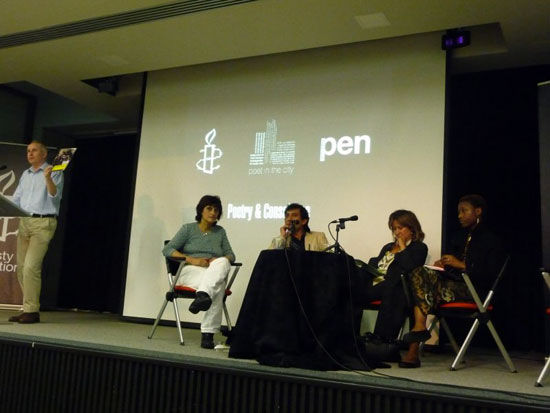
James Savage, Moniza Alvi, Abol Froushan, Dame Helena
Kennedy, Sifundo Mzebele
Poetry and
Conscience was the name of an event which took placed at the
Headquarters of Amnesty International in London on 23rd September 2008.
Graham Henderson on behalf of Poet in the City and English PEN welcomed
the audience and introduced the purposes of the event. Then James Savage
spoke about the action card on behalf of Amnesty International. He
finally asked Helena Kennedy QC to chair the event.
Helena first explained her own interests in Poetry And Conscience and
then in Paying tribute to the PEN ‘empty chair’, she read three poems by
writers
from Another Sky.
After the prelude, three guest poets read from their own works.
Sifundo (originally from Zimbabwe), (Abol Froushan originally from Iran)
and Moniza Alvi (originally from Pakistan) took centre-stage and read a
few of their own poems respectively.
In the second part after the break, a short panelled discussion and Q&A
sequence was held.
Four premeditated questions were the topic areas to which the poets
raised their views in turn.
1- What does the word conscience mean? Is poetry to appeal to the
conscience and speak of, for instance, human rights abuses?
2- If poetry is often about taking on voices in order to convey a
larger truth, is it then through artifice that we reflect best on
reality?
3- Is art always siding with what is right? What is the relationship
of poetry and the political conscience?
4- Is there a place for what we might call ‘domestic poetry’ or
‘poetry of the everyday’?
Abol Froushan
writes poetry in English and in addition has translated from Persian to
English of Ali Abdolrezaei's works.
A selection of Abol's poems titled "A Language against Language" was
published early this year in London. At the same time, a collection of
poems translated by him into English of Abdolrezari's poetry under the
title "In Riskdom where I lived" went to print by the Exiled Writers
Ink.
For Abol, the act of poetry is, physically, a state of concentration of
the mind so to maintain both a vision in its integrity and a formative
design for the transformation of the vision into words. In his state of
mental temperament, words in the process of poetic composition appear as
isolated objective 'things' with definitive sounding impacts. To
describe his 'pure poetry' vision, there is one qualification to make;
that is to say, his vision is expressed mainly by a musical equivalence
in the words. The new expressive moment in its particular significance
forms itself in the meaning of the whole, which in the new moment is not
inferred but newly born. Thus, reality at every point is drawn up from
the unknown.
His successfully adopted harmonic style is well reflected in the poems
published under the title "A Language against Language". In this
collection, a series of themes with specific illustrations is woven into
a web of continuous phonetic orchestration.
Abol Froushan's conception of musical poetry is such that it makes the
narrative text meaningful through music of heightened allusion.
Let us now read one of the poems he cited in the event.
There is no death in a
death
There is no death in a death that shadows me
Or ships into my body like a woman who denies me the thrill of
not having her
The place is the smell, the mystery of the first woman
Morning coffee opening the window
The father hanging the sea on the wall.
Anyone stricken by love calls me
So my enemies' butterflies can increase.
Any girl who touches her breasts so two birds can scar my heart
Will shrink away.
...
I love love when love recedes
I love the white lilly
When it withers in my hand and grows in my song - Wait for me,
my song.
***
Ali Abdolrezaei was born in northern Iran in 1969. Aside from being a
poet, he is also trained as a mechanical engineer. In 2003, he had to
flee Iran due to the serious scrutiny and censorship of his work. He is
now living in London. He has published 12-books of poetry and has one
forthcoming. The most authoritative collection of Ali Abdolrezaei's
poetry is I Live in Riskdom published on internet in Persian language
outside Iran in 2007. His poetry has exercised a decisive influence on
post-Revolutionary Iranian literature. This 12th poetry book brings
together a fascinating selection of themes by one of Iran's most
talented and extraordinary poets. It focuses on the feelings of anxiety,
isolation and the sense of loss that Iranian Diaspora, and artists in
particular, have been experiencing in the last 30 years. Abdolrezaei's
poetry shows that the contemporary art of Iran has been hugely
influenced by the traumatic historic events of the last three decades
and that they have affected millions of Iranians in one-way or another.
In the process of the session, Abol Froushan cited five poems of Ali
Abdolrezaei of which the following one constituted the prominent theme
of the panel discussion.
Album
This is my mum Isn’t she beautiful?!
This my brother and this my father!
If only he knew how I am door to door Poor thing!
This one is Sara the youngest this smiley face also…can’t remember
the name!
Exile, exile what havoc it’s played on my memory
She’s my eldest sister
She used to pass out laughing
when shooting pictures
I’m at a loss how these pictures taken from the lip of smiles
are movie of eyes that have cried
anyway never mind!
but how mixed up I am
Poor thing! my peasant mum!
If freedom ever visits Iran
you’ll become my father’s new bride
and after breakfast my sister
with frankincense will smudge round my head
to dispel the bad eye
on my having a woman in the night most
and my mum while boasting
will be throwing confetti and ululating in the paddy at the bottom
of the garden
so her son may eye up the sap of this lass and be turned on!
I’m turned on!
Now that we’re enthralled shoulder to shoulder in the hall of this
house
why not make believe we’re enfolded in the joy of reeves? Let go!
***
Moniza Alvi was born in Pakistan (February 2, 1954) to an English mother
and a Pakistani father. She moved to England at an early age (from which
point, as she comments in her fourth collection, Souls, she was
"translated into an English girl").
Alvi's voice has achieved a relaxed naturalness, a fluidity which allows
her to present poetry as though it were easy. She is a skilled
storyteller, recounting the extraordinary in the voice of the everyday
language. Moniza Alvi takes a more autobiographical approach to racial
conflict and the split between the East and the West.
She is concerned with both emotional and cultural splits. Surreal
reminiscences of homeland and the exploration of personal fragility
constitute two pillars upon which her poetry is based.
Moniza Alvi has written six poetry collections.
Moniza's latest collection "Europa" deals with issues of trauma and/or
post-traumatic stress disorder e.g. enforced exile, alienation, rape and
'honour killing'. The centrepiece in this collection is a re-imagining
of the story of the rape of Europa by Jupiter as a bull. Let's finish
off with one of Moniza Alvi's
Poems called "Would I Like to Be a Dot in a Painting by Miro":
I would like to be a dot in a painting by Miro.
Barely distinguishable from other dots,
it's true, but quite uniquely placed.
And from my dark centre
I'd survey the beauty of the linescape
and wonder -- would it be worthwhile
to roll myself towards the lemon stripe,
Centrally poised, and push my curves
against its edge, to give myself
a little attention?
But it's fine where I am.
I'll never make out what's going on
around me, and that's the joy of it.
The fact that I'm not a perfect circle
makes me more interesting in this world.
People will stare forever --
Even the most unemotional get excited.
So here I am, on the edge of animation,
a dream, a dance, a fantastic construction,
A child's adventure.
And nothing in this tawny sky
can get too close, or move too far away.
بازگشت |
