The aesthetics of the "Long Live War" Mansor Pooyan
Photo: Alvaro Ybarra Zavala
Ali Abdolrezaei is the author of twelve acclaimed poetry books which challenge traditional Persian poetic language. The main areas of the poem "Long Live War" are illustrated by the themes of love and war entwined in human affairs. The feelings and ideas associated with these are enacted upon in this poem. As well as the Iran – Iraq war during the Eighties, the poem can be read as a virtual depiction of a state of civil war in Iran between religious totalitarianism and secular pluralism. War in the shape of division and conflict recurs in this poem in varying themes: split families; friend who've turned cool; supporters who turn against the state; tensions between classes as well as between factions within a nation. War, however, was only one powerful agent of change at the beginning of post- Revolutionary Iran. In this epic poem love (in the form of sexual and patriotic) takes centre stage as the cause of the protagonist’s suffering. His return from the battle-front appears as a plunge into a disorientating nightmare of confused feelings. He walks into a society in which all areas of life are measured in terms of money. Now languid and moody, our `hero` begins to play poetically with words and discursively talks about front-line events. He decides to opt for a far more egoistic vein enjoying the pleasures of solitude and melancholy musing. As well as a sense of futility, the character often seeks and finds monetary renewal. Renewal can be finding a lost identity, marrying the right person, restoring broken relationships with the authorities or turning to fulfilment of unsatisfied desires. He is however pulled from two different directions: love and war. Many themes in the poem derive from these two ideas. After return, the protagonist is suffering from Post Traumatic Stress Disorder (PTSD). In addition, his patriarchical and at the same time puritanical religious inclinations have come in conflict with contemporary city life which demands he behave otherwise.
Let it be: everything in our home is now yours except whoever is outside the front door agreed?
With his marriage fallen apart, this disaffected ex-veteran turns to nihilism. He needs help, but all turn their back on him. His wife, his family and the state are not prepared to tackle an ex-veteran who is battling complex problems.
I realised: the place where a kissing lip is in short supply would be like a rooftop-edge working favourably only for Venus.
In this extract, the words cluster together to suggest the extent to which he is confused and disillusioned. Many words he uses have explicit sexual connotations. He had left his wife for martyrdom. Now minus a leg and directionless, he comes back to realise that his wife is marrying the cleric whose job was comforting the families of those fallen martyrs in the war.
How could I open the windows which are gone with the wind? The street has forgotten the night up to the last lamp-post.
The fallen cadence (the gradual drop in the pitch of the voice as the sentence unfolds) tells us that he has lost two wars. He is now resentful that he lived up to the manipulative images and expectations of the clergy. He acted out his role in compliance with what he was told by the theocratics. In other words, it was simply a matter that convention required him to do so. According to the interpretation of religious fundamentalists, the essence of Koran means that he should model his behaviour on what it says.
My hands on my head were thinking, reminiscing about that shell-hit day and the companions who have left me behind. The frontiers continued as long as there was any chance of martyrdom.
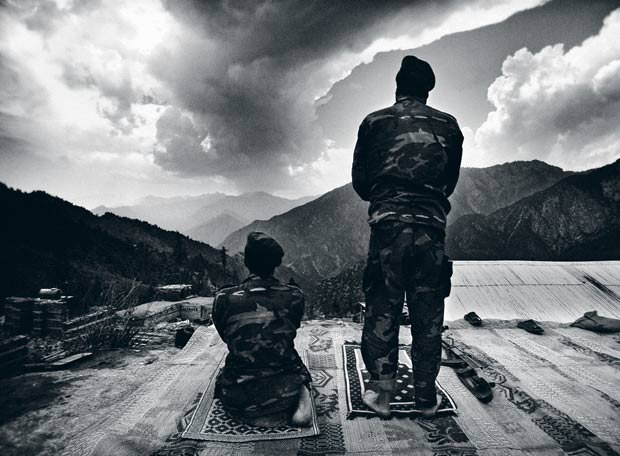
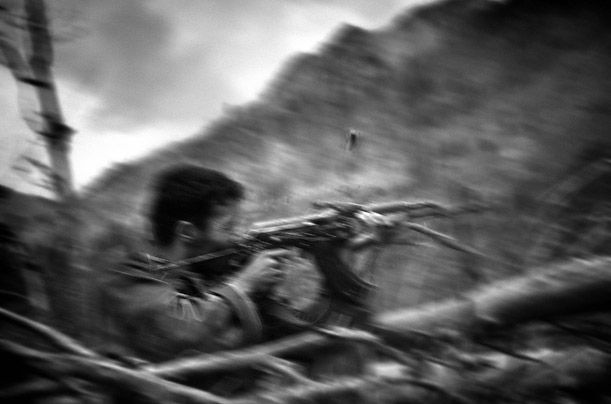
During the Iran-Iraq war, thousands of Iranian youth voluntarily walked through Iraqi mine fields to clear a path for Iranian tanks and artillery divisions. Mass volunteers marching in the streets indicated a readiness to become martyrs for the Islamic cause.
We have proper and smart trenches We are carrying guns on our shoulders Our hearts are full of love for our countrymen In every shell, we have a cartridge….
This is a song extract exemplary of the methods used to forge a sense of solidarity, enhance mass mobilisation and preserve the sacred values of the martyrdom. Despite Iraq's superior fire-power, Iran mobilised repeated human wave assaults on Iraq's fortified positions. Heroic exploits were prefaced by nights of prayer and fasting. In popular culture, lay thinkers perceive of martyrdom as a symbol of communal cleansing and regeneration. Throughout the history of Iran, martyrdom has been a recurring phenomenon to celebrate and safeguard the sacred boundaries.
At the front, I had a broad shoulder to take on difficulties I had no inclination to go after my business I had no desire for stories and buffooneries At the forefront on the attacking line you could easily distinguish wantons turned now to patriots
This is the voice of a layperson having abandoned his lifestyle to seek martyrdom at the war. He is mocking the protagonist for losing faith and being a detached cynic turning to literature as a substitute for creating meaning in life. What seems interesting in the above stanza is the delicacy of the contrast between the altruistic sacrifices made by this lay character and an idiot's delusion brought in earlier in the poem. One of the questions haunting the character in his traumatised crisis is the extent to which he is no longer free as a hero to act. Paradoxically, as a part of his new standpoint, he has come to realise that the reason why things are as they are lies not in fate or God’s will, but in us. He remembers words any commander had to use to steel the nerves of his troops on the eve of vital battles, thus creating a sense of brotherhood in the imminence of battle. Amid a barrage of enemy fire, soldiers (better to say a band of self-styled martyrs) while holding the line would continue to walk steadily towards the enemy.
After the battlefield sacrifices, the armed militias were promoted as army officers. The pilgrims of Karbela left the path and became nouveau riche Tehranis. Whether you like it or not they were the squatters like the cuckoo snatching their rich pickings from abandoned dwellings.
Photo: Alvaro Ybarra Zavala
Some of those commanders have now ended up in high ranking authority job positions. They comforted soldiers with the belief that since they had been chosen by God, they wouldn’t be defeated. These corrupted officials still use high-sounding language to bolster their positions. The word "Wavy" is slang used colloquially in Iran to depict the state of mind of such fanatics coming back from front lines with PTSD. The word "Wavy" also implies it was the hitting waves of an explosion causing damage to the orderly functions of the brain. That is why an Armenian father denies the protagonist an agreement regarding a marriage request:
Me! An Armenian wouldn't give a daughter to someone outside my clan `Shamlou` one who may inflict suffering on my poor child
One of the most important forms of not belonging is being lost. He is physically, emotionally and, in so far as he fears for his sanity, mentally lost. Revelation comes in different ways. The character comes to realise his circumstances through self-knowledge, an encounter with a friend and in the light of societal reactions towards him.
People look at my empty folded trouser leg as if from a watchtower scrutinising my abnormality.
As a result of change of heart, the "Wavy" has forgotten about virtue and that part of religious faith emphasising sacrifice and martyrdom. The current extreme character of his feelings is in sharp contrast with his previous state of mind.
I am proceeding aimlessly! I've left loose- half way through- the task of buttoning up loneliness is the state I am in I am rehearsing my voice whispering for a woman that is about to ring…
The words above indicate that as sexually oriented person he has a purely instrumental approach. The desperation, suspicion and bitter feelings of rejection all in all force him into a direction seeking momentary pleasures with little awareness of the possible outcomes.
I am far away! with no option but to draw out my frightened car and skid a break upon someone's lips thus to carry my cross from the mine field
Although the "Wavy" knows that he is no longer inspirational, yet the reader sees that for much of his disenchanted life he remains fearful and hedonistic. He can’t live peacefully, left with the certainty that he is undesirable and exists on the margins of society. His idealism goes astray and reality begins to take its toll as we witness a change of character.
I am Amroaas the sweetheart of all Tehran's girls My embrace is still a wise hotel in which one night stands are free of charge
Here an idiot- a victim of urban corruption-is boastful of taking advantage of the pervasive chaotic circumstances following the Iran-Iraq war. Under influence of such voices, the "Wavy" is tempted to lead a pervert lifestyle. This inclination is one of many other impulses he is bombarded with. In this crisis, he ceases to be a man of principles and reveals that he's a shrewd and cunning opportunist. The driving force behind his actions in the second part of the poem is the search for identity. He wakes up to his real feelings as to what he really feels for the "Other" e.g. the opposite sex. The ending resolves what the poem as a plot has opened up. The closing down of the story is signalled by a turning point in a downward direction. The character is pursuing his inevitable course to a tragic close.
Tomorrow what will be on the cards…I don't I know There might be a bullet in this plot aiming at a heart that is no longer worth it In my hand who has played open his card? Is it me
At the winding-up of the poem, the narrator speaks of the awesome nature of his poetry: depicting a society torn apart by post-revolutionary disasters.
Don't look at my verses those disconnectedly are speaking nonsense The sketches of my poems are dragged out of pain…
In terms of literary form, the story ends as it began. Events illustrated in earlier parts of the poem come to have very different meanings when viewed from the narrator's perspective. This effect of dramatic irony emerges right at the end. Throughout the poem, we see the "Wavy" as a lonely, tortured soul struggling with his conscience and haunted by atrocities. He who volunteered to fight at the battlefront, now a tragic character, is left live in fear. He retreats to woodlands of the Northern Iran to endure his isolation away from the capital's condensed structures. His character though can be viewed as a case for psychological and sociological analyses. The entrance of the narrator into the arena at the end compels us to view the events from the intellectual standpoint of the poet. The poet shows us that people inevitably behave in accordance with socio-cultural conventions. To transform existing life patterns, new discourses and modern interpretations of traditions are needed. The poet strips away the robes and power of religiosity to reveal the struggle of our common humanity. Ali Abdolrezaei usually exposes the undesirable aspects of the Iranian status quo through a clever, and sometimes quite bewildering, use of language. Abdolrezaei as a sharp-minded intellectual plays with the multiple meanings of words. Thus, one of the outstanding characteristics of his poetry is its receptiveness to language impressions. The rather informal air of the "Long Live War" is reinforced by the colloquial forms which are quite ironic to the archaic forms of the conventional Persian poetry. A vital principle of the language of this poem is that the words can be performed. They are not merely spoken, they can be acted out. Like a dramatic text, the poem is physically embodied. In addition, the language makes an imaginative appeal through the senses. The rhythmic and tonal change accumulatively resulting in a synthesised effect on the reader for a more pro-active understanding of the poem. This epic poem is characterised by the absence of a linear narrative and chronological order. Thus, the reader plays a more active part in relationship to the multi-dimensional facets of the poem. Since different characters are cast in roles throughout the verse, the reader can distinguish which character is conjured or enacted upon by the "Wavy" simply by change of colour.
Finally, one of the satisfactions of the poem is being on `the inside` of an Iranian ex-veteran's thoughts and feelings.
June 2008
|
 |